
Wang Xiangzhai’s Yiquan Training System: the 7 Steps
The Art of Yiquan.
A relatively young Chinese martial art style, Yiquan is only about 100 years old, though it is based on principles and training methods utilized for at least 3,000 years. The style’s founder Master Wang Xiangzhai (1885–1963), after many years of studying Xingyiquan, created the new style which places greater emphasis on static postures (Zhanzhuang) while deemphasizing forms, opting instead for spontaneous expression of creative power in the moment. Master Wang named the new art Yiquan and gradually developed the seven step Yiquan training system.
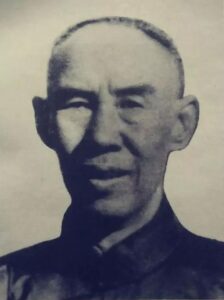
Wang Xiangzhai (王芗斋)
During the 1940s a group of well-known martial artists hailed this new martial art style and suggested another name – Dachengquan. “Dacheng” means “Grand Achievement”. Master Wang protested, “Achieving is infinite, how can there be grand achievement?” Nevertheless, many of Master Wang’s successors still use the name Dachengquan today. While Yiquan and Dachengquan refer to the same martial art style, we use the name Wang Xiangzhai preferred – Yiquan.
In Chinese, the word quan (or chuan) literally means fist. It represents a style of Chinese martial arts (i.e., Taijiquan, Xingyiquan, Shaolinquan, etc.). In a general sense, quan represents martial arts or boxing. In China, when someone says, “I practice quan”, it means, “I am a martial art practitioner”.
Yi is a mental intent to initiate action. For example, when one is thirsty, one’s mind generates an intent (or a Yi) to drink some water, one’s hand reaches for a glass of water, and then one drinks. A mental intention initiates a physical action. The physical action is the outcome of the mental intention.
Yiquan combines both physical and mental training. The name Yiquan indicates that the art’s training emphasizes the mental aspect over the physical. Mind over matter. Yiquan training consists of three goals – 1) maintain and improve health; 2) hone combat and self-defense skills; and 3) cultivate wisdom.
Yiquan firstly maintains and improves physical health. Yiquan brings together the essence of ancient Chinese wellness philosophies and modern western sciences to develop a mature, thorough, and effective method of health maintenance.
Yiquan’s static postures build and circulate qi/chi (bioelectricity) throughout the body. These static postures have been used since prehistoric times by Taoist shamans and alchemists to cultivate vitality, energy, and awareness. Scientific research in modern kinematics, human anatomy, neuroscience, physiology, and psychology have all validated the health effectiveness of Yiquan practice.
Yiquan secondarily hones self-defense skills. Yiquan has preserved and developed the combat effectiveness of traditional Chinese martial arts. Yiquan doesn’t use forms in the same way as most other martial arts. Instead, it utilizes practical techniques and drills for stimulating and developing one’s ability to react instinctively and effectively to any improvised situation. Yiquan is a highly effective, highly practical method of self-defense.
Finally, Yiquan cultivates wisdom within the practitioner. The Chinese term “li qu” may be roughly translated as “to pursue philosophical interests”. Yiquan training yields an organic self-reflection and contemplation free of external dogma or ideology.
Through Yiquan we may reflect on our self, our life, our environment, and on our universe. Yiquan practice evolves our thinking about ourselves and the world by expanding our awareness. Each practitioner may derive different philosophical interests from Yiquan learning depending on the unique nature and mind of the practitioner.
While Yiquan itself is a relatively recent martial innovation, like its sister internal martial arts (Taijiquan, Baguazhang, Xingyiquan, Liuhebafaquan), it is rooted in ancient mysterious Taoist principles and practices that have the power to transform the persistent practitioner at the deepest levels towards the embodiment of their total human potential. Consistent Yiquan practice, over time, unifies the entire body with the whole mind creating an integrated and robust experience of life.
How Is Yiquan Taught? The Seven-Step Yiquan Training System
Yiquan can be learned in a very clear, systematic and cumulative progression of instruction consisting of seven steps. Each step is designed for a purpose with specific corresponding training. The seven steps of Yiquan training are Zhanzhuang, Shili, Mocabu, Fali, Shisheng, Tuishou (also known as pushing-hands), and Sanshou (also known as sparring).
- Zhanzhuang is Force-searching
- Shili is Force-testing
- Mocabu is Force-moving
- Fali is Force-releasing
- Shisheng is Sound-testing (Force-articulating)
- Tuishou is Force-activating
- Sanshou is Force-expressing
Zhanzhuang is the first step and the foundation of the entire art. Next one learns Shili, then Mocabu, then Fali, etc. in progressive steps. No matter how long one has been practicing Yiquan, whether for months, years, or decades; no matter how advanced one is, even for a qualified instructor or a well-known master; one needs to practice Zhanzhuang and all the other steps consistently.
The combination of the seven steps is a spiralic progressive study. It is critical to practice Zhanzhuang every day. Zhanzhuang is the heart and soul of Yiquan. High level mastery of Zhanzhuang is an indispensable prerequisite to the other steps. The longer one stands in Zhanzhuang, the easier it is to master the remaining steps.
Yiquan specifies: “Mastering Zhanzhuang equals mastering 90% of Yiquan.”
The First Step: Zhanzhuang – The Heart of Yiquan.
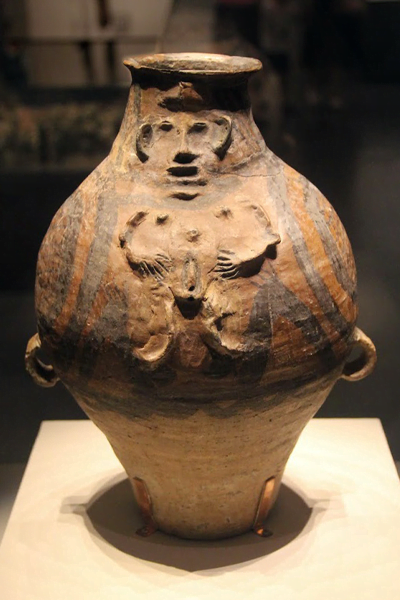
An elegantly simple training method, Zhanzhuang enhances vitality, energy, and awareness in the practitioner. Zhanzhuang is ancient and time-tested. A 7,000-year-old Neolithic pottery vessel from China’s Majiayao culture, unearthed in 1975, shows a figure performing Zhanzhuang. Master Wang Xiangzhai built Yiquan upon the ancient Taoist standing practice of Zhanzhuang.
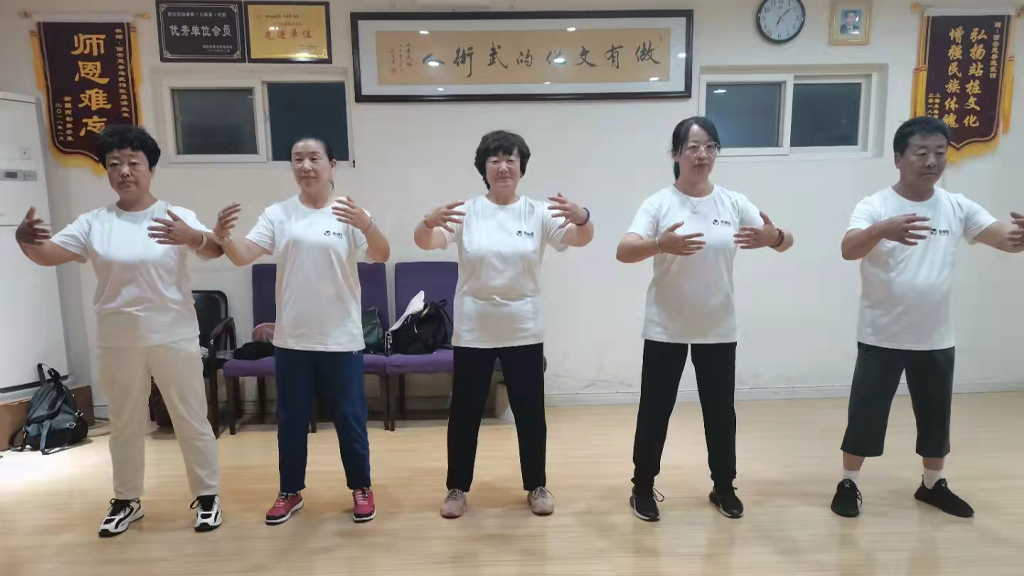
Zhanzhuang strengthens and tones muscles, tendons, and ligaments, while balancing internal organ function. It serves as the foundation for power and coordination in the “internal” martial arts (Yiquan, Taijiquan, Xingyiquan, etc.). As a meditation, Zhanzhuang offers a method to practically embody and viscerally experience the philosophy put forth in the venerable Tao Te Ching.
Zhanzhuang is the indispensable core of Yiquan. The beginning and the end of Yiquan training, Zhanzhuang is the practice of “Force-sensing”. In this practice, Yi (mental intent) directs force (physical movements) to coordinate toward ever-increasing unity. Zhanzhuang aims to integrate the body’s myriad parts into an “organic whole”. This organic wholeness means all the body’s parts are unified as “one”.
Forces generated by body parts are called “scattered” forces and are often inefficient and therefore ineffective. Movement generated by the body functioning as an integrated organic whole expresses as “whole-body” movement. Force generated by whole-body movement expresses as “unified” force. As the first step in Yiquan training, Zhanzhuang pulls scattered forces into a power-packed “unified” force through a process of “Force-unification”.
Zhanzhuang represents an overall training method consisting of a variety of static postures, all of which share identical principles of alignment conducive to force-unification. The Expanding-Embracing (Chēng Bào /撑抱) Stance, also known as Hún Yuán (浑圆, “Completely Round” or “Round Smoothness”) stance, as a parallel-step stance, functions as the essential Zhanzhuang posture. When we change palms to fists, Chēng Bào becomes Yiquan’s basic combat frame from which all martial force is generated.
The practice of Zhanzhuang transforms the body into a big spring. When throwing punches, the spring spins, and the spinning spring generates a spiral, elastic force possessing “penetrating power”. Yiquan’s punches are not mere fist-throwing. Rather, when punching, we throw the whole body and the force generated by whole-body throwing is extremely powerful in its explosive execution.
Zhanzhuang can have all the appearance of magic. It is simple, gentle, and nonviolent, while optimizing a practitioner’s explosiveness and absolute strength for self-defense. Fundamental to Yiquan, Zhanzhuang must be practiced consistently and cannot be replaced by any of the other Yiquan steps. Without sufficient Zhanzhuang training, no matter how long or how hard you practice the rest of Yiquan’s steps, the expression of explosive power and extreme strength will simply not exist.
Zhanzhuang is also one of the best ways to maintain and improve health. When we refer to the health effects of Yiquan, we mainly mean the health effects of Zhanzhuang. Remember, Zhanzhuang is 90% of Yiquan.
Zhanzhuang immensely benefits the weak and elderly; those suffering from chronic disease; the many of all ages suffering from the ravages of office life (back pain, neck pain, insomnia, hemorrhoids, etc.)
Yiquan specifies, “Start with Zhanzhuang to pursue the essence of Quan (martial arts).”
Zhanzhuang, consistently practiced and applied, infuses any martial art style with unparalleled vigor, power, and creative adaptability.
Beginner Zhanzhuang (Health Stances) Online Course
Course Level: Beginner
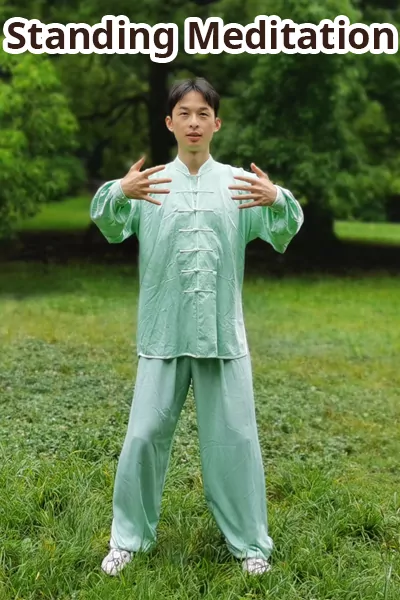
This is a systematic self-study Zhanzhuang (Standing Meditation) course to develop your body and mind to a greater level. Your health condition can be improved quickly.
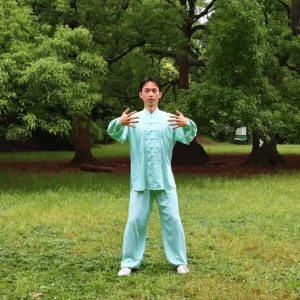
Advanced Zhanzhuang (Combat Stances) Online Course
Course Level: Intermediate
This course will challenge you but provide with you a new horizon of Zhanzhuang. You may obtain quicker and further health improvement.
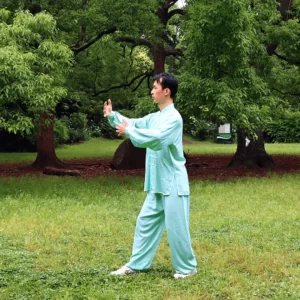
Special Stances Online Course
Course Level: Advanced
The Tiger Stance, Dragon Stance, and One-Legged Stance are known as special stances—demanding postures that cultivate internal power, balance, and rootedness.
They require a profound grasp of body mechanics, relaxation, and the harmonious integration of mind and body.
Practicing these stances can elevate leg strength, whole-body balance, and coordination to extraordinary levels.
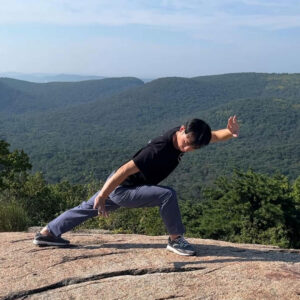
Zhanzhuang for the Elderly, the Weak, and People with Limited Mobility
Course Level: Beginner
This course is designed for older adults, people who are physically weak, and those living with disabilities or limited mobility.
This course may also be suitable for people recovering from an injury or major surgery, as well as those experiencing reduced strength or mobility after illness or an extended period of inactivity.
The Second Step: Shili – Force Testing.
Shili is the second step of Yiquan training and can be translated as “Force-testing”. This practice aims to thoroughly cultivate the “unified” force.
Shili draws the outer stillness of a Zhanzhuang static posture into motion. Pausing Shili at any point during a movement’s progression creates a Zhanzhuang stance.
There are hundreds of places in space to pause a Shili movement creating hundreds of possibilities for various Zhanzhuang stances. While there are no particular names for the various Zhanzhuang stances that may lead into or emerge from Shili motion, these are all stances nonetheless to the extent that each stance maintains Zhanzhuang’s essential structural integrity. These stances connected in sequential motion comprise Shili. Shili is the spatial extension of Zhanzhuang.
Technically, Zhanzhuang searches and develops the unified force in motionless movement or minimum movement, while Shili cultivates the “unified” force in slow movement.
Yiquan specifies: “Force is known through testing.”
Yiquan Park offers online courses to learn Shili by yourself.
Basic Shili(Force testing) Online Course
Course Level: Beginner
As an interesting exercise that can be applied to health development, Shili (force testing) prepares basic movements for self-defense skills from Yiquan martial art system. This online course introduces 10 kinds of Shili training on the Parallel Step.
It’s a crucial step in Yiquan, bridging the static posture practice of Zhan Zhuang to more dynamic applications.
The Third Step: Mocabu – Footwork.
Mocabu is Yiquan footwork and comprises the third step of Yiquan training. Mocabu means “Friction steps” in English. This is the practice of “Force-moving”, which aims to properly move the “unified” force for combat purposes.
Specifically, the practice of Mocabu enables us to step while maintaining the unified force, developed and cultivated Zhanzhuang and Shili. Mocabu is essentially Shili of footsteps. Mocabu can be practiced with Shili.
Mocabu comprises a step of its own in the Yiquan system because footwork is so critical in combat. Only when the unified force is maintained in stepping can attack, defense, and counterattack be efficient and effective.
While Zhanzhuang searches and develops the “unified” force in motionless movement or minimum movement, and Shili cultivates the “unified” force in slow structurally integrated movements, Mocabu further develops and cultivates the “unified” force in motion.
Yiquan specifies: “Use non-fixed steps as steps; use non-fixed rules as rules.”
Yiquan Park offers online courses to learn Friction Stepping by yourself.
Friction Stepping Online Course
Course Level: Beginner
Friction Steps can be practiced as an effective leg-strengthening exercise, building powerful legs while improving balance and footstep alignment.
For those interested in self-defense, this training introduces the fundamental & essential footwork of traditional Chinese martial arts—skills that can be seamlessly applied in real combat situations.
Combat Shili Integrated with Friction Stepping Online Course
Course Level: Intermediate
The Fourth Step: Fali – Releasing the Force.
The practice of “Force-releasing”, Fali is the fourth step of Yiquan training. Fali is dedicated to supplying power for combat. Once a certain level of force-unification has been reached through the practice of Zhanzhuang, Shili, and Mocabu, we train to release the unified force in one split second. The unified force cultivated in Zhanzhuang, Shili, and Mocabu transforms into power in this step.
Force-releasing can be understood as Power-releasing. Combat cannot be fulfilled without power. Power is combat’s engine. Fali is essentially the acceleration of Shili. Shili, when gradually sped up, becomes Fali. Fali, slowed down, becomes Shili.
Technically, Zhanzhuang searches and develops the unified force in motionless movement or minimum movement. Shili cultivates the “unified” force in slow movement. Fali cultivates the “unified” force in fast movement or instant movement. Fali is the integrated embodiment of Zhanzhuang, Shili, and Mocabu.
Yiquan specifies: “Force arrives as Yi arrives; Yi and Force are not separate.”
Yiquan Fali/Fajin Online Course
Course Level: Intermediate
Fali is the fourth step of the Yiquan system and focuses on generating power for real combat. After achieving a high level of whole-body integration through Zhanzhuang, Shili, and Friction Stepping, training shifts toward releasing that unified force in a split second.
Yiquan Striking Online Course
Course Level: Advanced
In Yiquan, Fali is trained as the expression of explosive power for practical combat. In this course, the basic Fali movements are developed into functional striking methods. You will systematically study punches, kicks, palm strikes, as well as knee, elbow, and head strikes. These striking methods are practical combat techniques built upon the foundation of whole-body power.
The Fifth Step: Shisheng – Sound Power.
As the fifth step of Yiquan training, Shisheng stimulates the whole body’s muscle fibers to work more effectively through “sound-testing”. Shisheng compensates for deficiencies in Fali practice. Technically, Shisheng is essentially a supplemental exercise to Fali.
The combined practice of Fali and Shisheng coordinates the inside and outside of the body, with the intent of generating sound and force at the same moment. Shisheng is a highly specialized skill and should only be practiced under the supervision of a qualified instructor.
The Sixth Step: Tuishou – Pushing Hands.
In English, Tuishou means “Pushing-hands”, a relatively well-known English term thanks to Taijiquan’s approximately 60 years of influence in the West. Pushing-hands is the practice of “Force-activating”, dedicated to activating power for combat.
When we are able to properly perform the first five steps, Pushing-hands initiates partner training as both sensitivity building exercise and preparation for sparring. We learn to perceive, control, and defend attacks and to strike the opponent (our training partner) during the practice of Pushing-hands. In this step, we and our training partners learn to activate power without harming one another.
Pushing-hands functions as the integrated embodiment of Zhanzhuang, Shili, Mocabu and Fali, and can be understood as Shili with two practitioners under pressure. It tests whether we can maintain the unified force under confrontation.
Combat practice can be dangerous and can cause serious injury or damage to practitioners. Pushing-hands allows combat training without the risk of injury and prepares practitioners for combat.
Yiquan specifies: “Defend the center; use the center.”
The Seventh Step: Sanshou – Sparring.
Sanshou (Sparring) is Yiquan’s seventh and final training step. All of Yiquan’s previous practice result in Sparring. Sparring is the practice of “Force-expressing”. We express not only our power, but also mental discipline, courage, toughness, stability, and the ability to improvise in combat with our opponent (our training partner). Only through the seventh step can we develop practical self-defense techniques.
Injuries can happen during Sparring practice, so it should only take place under the instruction of a qualified teacher.
In the beginning step of Sparring practice, if we discover we are not ready, either physically or mentally, we should return to Pushing-hands. Pushing-hands can remedy Sparring deficiencies; however, Pushing-hands cannot replace Sparring. If we want the ability to defend ourselves in actual combat, Sparring is obligatory. This applies to any martial art style.
Yiquan specifies: “Only through hundreds of combats should one become a well-versed master.”
A Summary of Yiquan’s Seven Steps
Yiquan training consists of seven steps, each one purposefully designed.
- In Zhanzhuang, the practice of “Force-searching”, we search for and develop the “unified” force through motionless movement or minimum movement.
- Shili is the spatial extension of Zhanzhuang. As a practice of “Force-testing”, Shili cultivates the “unified” force through slow movement.
- Mocabu is the practice of “Force-moving” and cultivates the “unified” force in motion. Mocabu is essentially footwork with Shili.
- Fali is Shili accelerated. This practice of “Force-releasing” cultivates the “unified” force in fast movement or instant movement. Fali training supplies power for combat.
- Shisheng (Sound-testing) is a supplemental exercise to Fali, and culminates in the ability to coordinate vocalizations with strikes.
- Pushing-hands (Tuishou) is the practice of “Force-activating”, dedicated to activating power for combat. Tuishou prepares practitioners for combat. Pushing-hands may be understood as “Double-man” Shili.
- Sparring is the practice of “Force-expressing” and is the culmination of the other six steps. The primitive meaning of Yiquan Sparring is the bare-handed combat with no restrictions in terms of how the body is used to express techniques. Hands, feet, shoulders, knees, elbows, and even head can all be used. With the instruction of a qualified teacher, we can develop highly practical, highly effective self-defense techniques.
This is the path to Yiquan mastery. It takes many years and much persistence to complete. Always remember, 90% of Yiquan is Zhanzhuang, and without adequate Zhanzhuang training, Yiquan cannot bear fruit.
About the Instructor
I am Song GAO, Yiquan inheritor & instructor, Zhanzhuang expert in health & wellness.
I was born in 1987 and grew up in a village in China. I began professional Yiquan and Zhanzhuang training with Master Zhang Yongmou, a fourth-generation Yiquan inheritor, in 2016.
After four years of training at Master Zhang’s Yiquan school, including three years as an assistant instructor, I became qualified to teach. I began teaching online in early 2020.
I traveled to the United States to teach Zhanzhuang and Yiquan in both 2024 and 2025.
I accepted my first two disciples in 2024: Hosh from Bisbee, Arizona, and Lyle from New York City. In 2026, Gregor from Slovenia became my third disciple.
In 2026, I largely achieved my goal of becoming a full-time Yiquan teacher.
This is really helpful. Thank you.